GridRaster brings Spatial AI to refineries, processing plants, offshore facilities, and
pipeline networks. SPIDER turns pressure vessels, piping, and rotating equipment into live
spatial data that inspectors, technicians, and robotic systems all work from — compressing
turnaround windows, reducing time spent in hazardous areas, and building a traceable
integrity record across the asset’s service life.

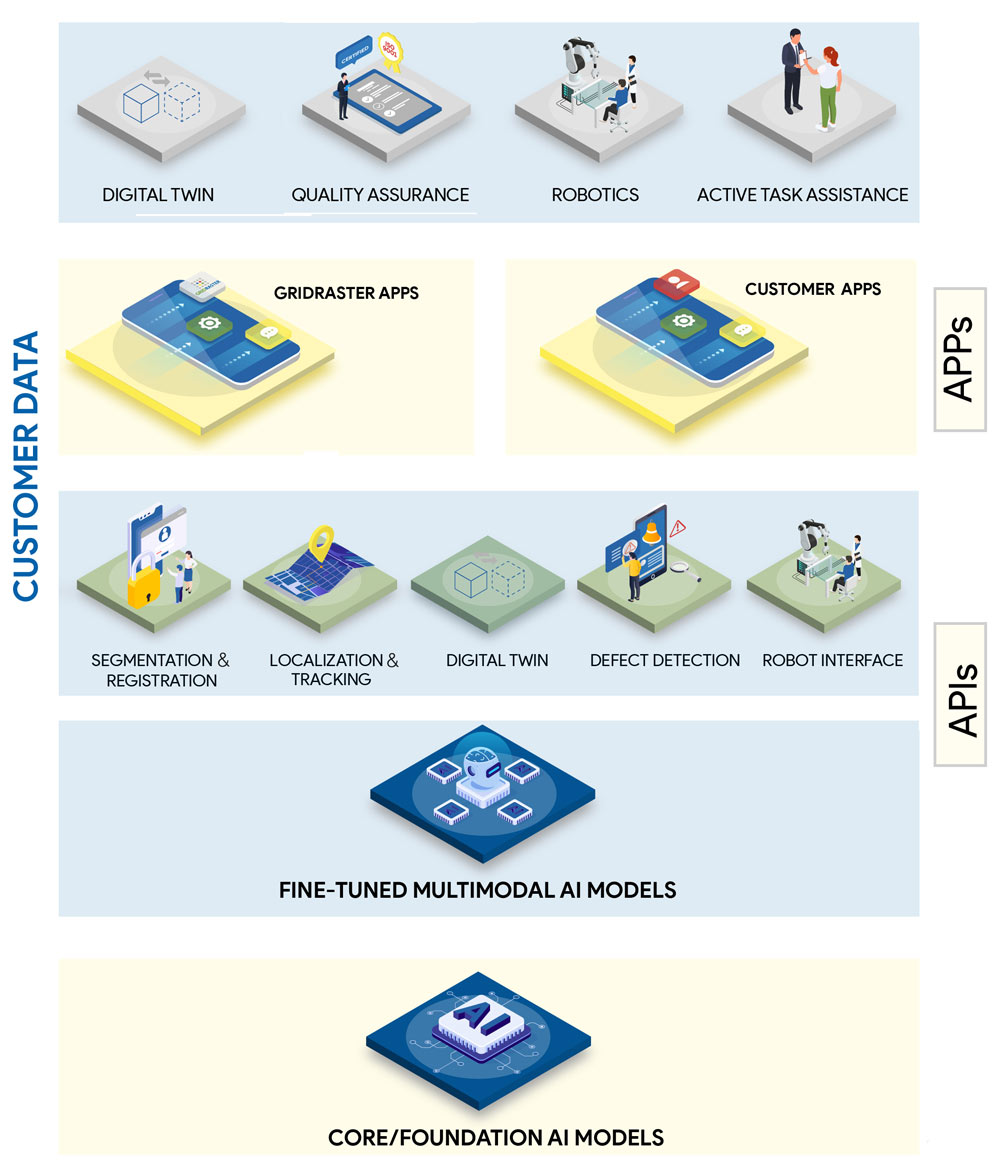
Figure:- GridRaster’s Unified and Shared XR Infrastructure Platform
Process facilities never hold still — scaffolding moves, equipment is opened and reassembled, and access changes hour to hour through a turnaround. Traditional robot vision depends on fixed positions and pre-programmed paths that these environments break. SPIDER localizes the target, identifies the area of interest, maps surrounding obstacles, and streams that spatial data directly to the robotic controller.
The planned motion is simulated and previewed for the operator, who reviews and approves before anything executes — keeping human judgment in the
loop while removing people from confined and elevated work.
Thickness readings, weld findings, corrosion measurements, and inspector notes are typically captured by hand against a drawing reference or stored in systems disconnected from the equipment itself — making it difficult to compare a reading to the one taken at the same point during the last outage. SPIDER tracks inspection tools in real time and anchors every reading to its precise location on the physical asset and on the model, building a contextual
record on a single unified data layer. An eddy-current probe moving across a surface has its full path traced live and overlaid on the twin. A tactile sensor capturing fine scratches, pitting, and surface defects has each image mapped to the exact point it was taken. Surface defects are detected and classified automatically rather than left to visual judgment that varies by inspector and shift.
Assistance is dynamic, not a static work instruction. SPIDER detects the equipment, aligns its digital twin to the physical surface, and shows the target in place — flagging errors as they happen and confirming each step before anything is committed.

Products
Resources
Industries
Company