Industries
Spatial AI for production cells, work cells, and industrial sustainment: robots, inspectors, and technicians on one spatial model.
GridRaster brings Spatial AI to manufacturing floors, robotic work cells, and industrial sustainment operations. SPIDER turns parts, assemblies, and tooling into live spatial data that robots, inspectors, and technicians all work from: setting up robots in minutes on parts that arrive in a different position every time, anchoring quality findings to the part and its CAD model, and delivering technical data on the surface at the moment of work.
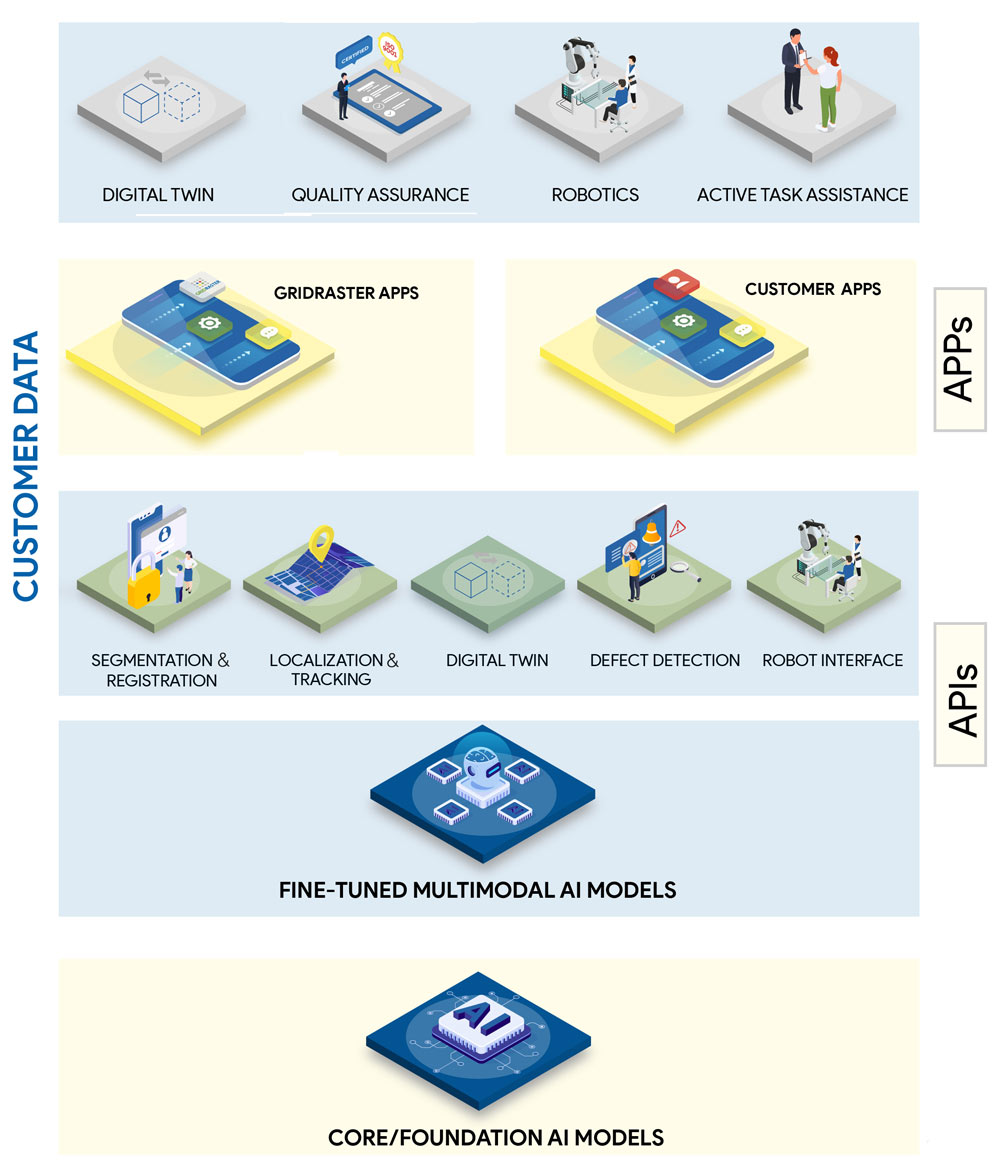
Figure: SPIDER platform architecture
Welding, grinding, blasting, painting, and material handling are labor-intensive and hazardous, and every part enters the work-cell in a different position or condition, so the robot is set up again for each job. SPIDER recognizes the part with no markers, localizes the regions of interest and keep-out zones from its digital twin, and converts the operator’s XR selection into robot-ready coordinates sent to the controller over encrypted APIs. The operator approves each critical step before it executes, and the robot re-plans as people and equipment move across the floor.

Weld findings, surface defects, and coating coverage are usually recorded apart from the part they belong to. SPIDER tracks inspection tools in real time and anchors every reading to its location on the physical part and its CAD model, on one unified data layer: a tactile tool’s surface captures mapped to the exact point they were taken, liquid penetrant indications detected and classified automatically with pass/fail reports, and one traceable digital work record per part and serial number.
Assistance is dynamic, not a static work instruction. SPIDER aligns the digital twin to the structure and overlays each component’s location and sequence for assembly and installation, confirming correct placement as work progresses and leaving a verifiable record. Errors are flagged in-process rather than found at final inspection, and legacy 2D data reaches the operator in 3D, on the part.

Products
Resources