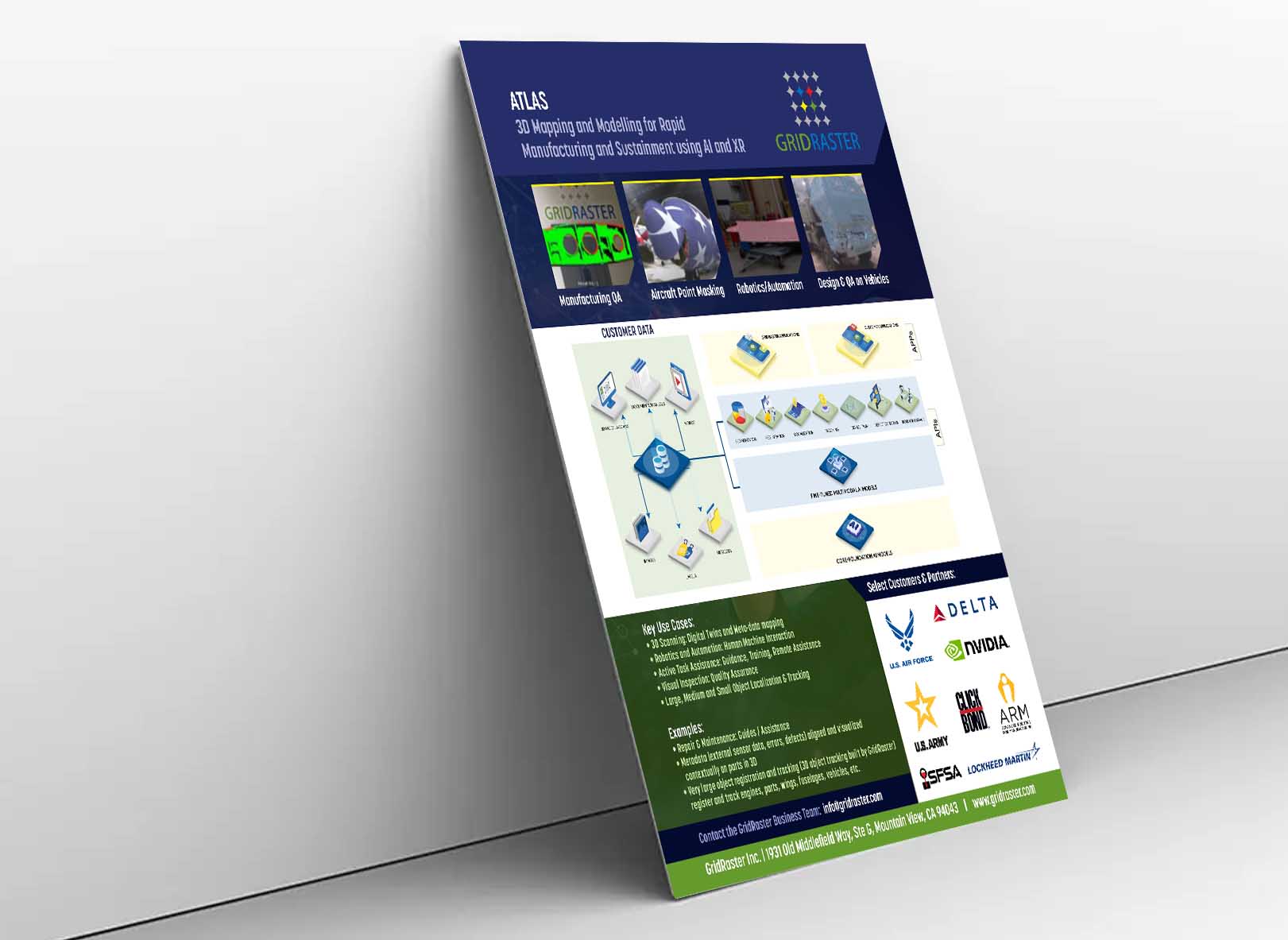
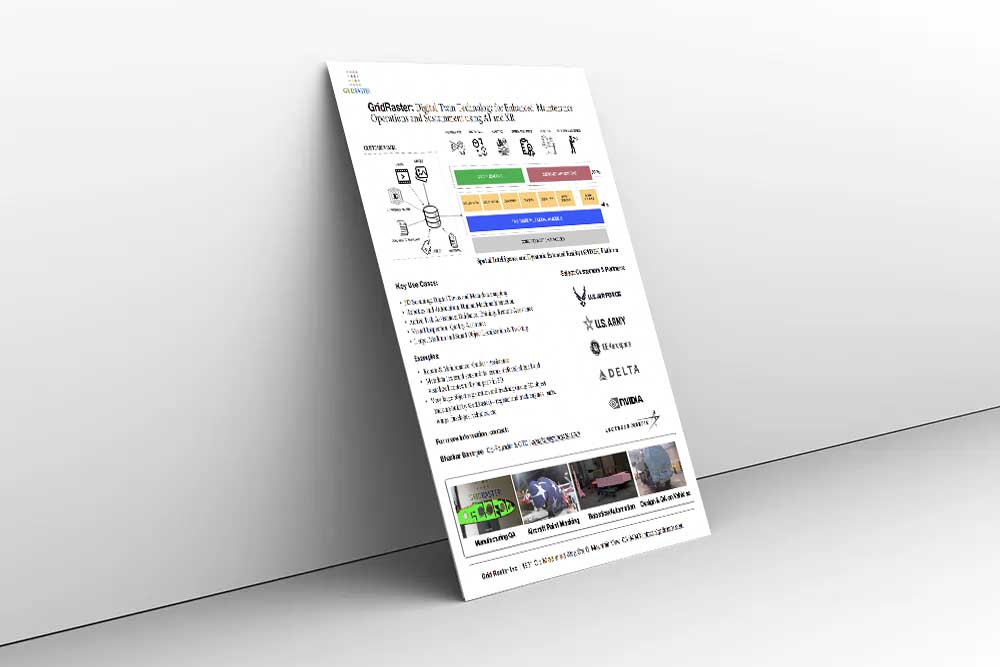
A succinct overview of our spatial intelligence platform for aerospace, defense and industrial applications, its value propositions and our company overview.
1.5MB
An overview of the SPIDER platform, its use cases, and our approach to each.
1.7MB
A selection of our latest technology demonstrations, organized by critical use case. Click below to jump ahead to a specific section:
A technician co-localizes an aircraft vertical stabilizer and an autonomous mobile robot in a shared space and marks the inspection area. SPIDER passes the spatial data to the AMR, which plans its path and previews its arm motion in Apple Vision Pro for operator approval before it moves.
Duration 1:27
Watch how an operator teaches a robot a new task by performing it, with no hand-coding, using SPIDER’s Spatial AI and simulation capabilities.
Duration 0:35
SPIDER segments every object in the space, generates 3D bounding boxes, and exports object transforms in real time, feeding robot path planning and downstream automation directly.
Duration 1:37
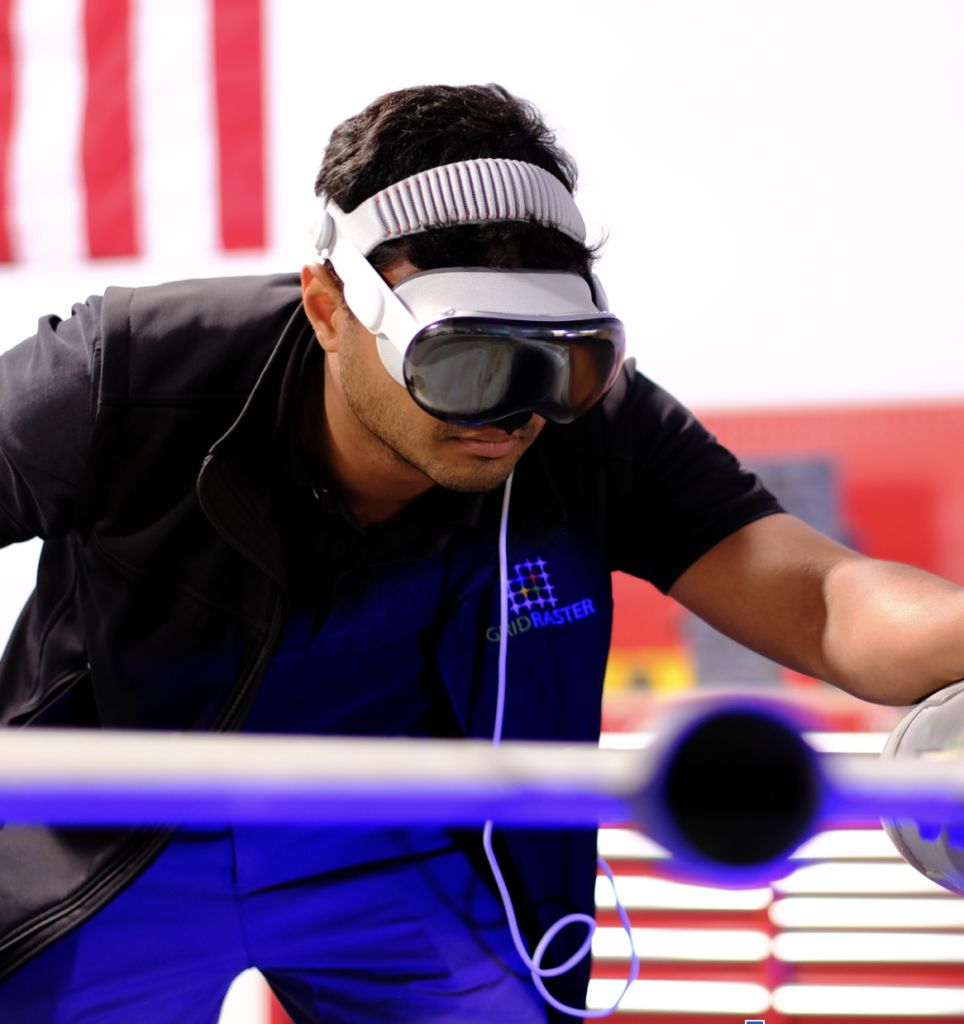
With SPIDER, every inspection output (tool-tracked readings, detected defects, full part geometry) is anchored to the part and its digital twin on one unified data layer. Running on Apple Vision Pro, SPIDER recognizes the part, tracks each inspection tool in real time, and pins every result to the spot where it was captured.
Five modalities on one aircraft,
unified onto a single twin: 3D tactile, laser capture of full part geometry, eddy current with live scan-path tracking, X-ray plate placement linked to the digital task order, and microwave inspection. Instead of disconnected sheets and photos, teams get one spatially traceable record per asset: what was inspected, where, and by whom, feeding downstream maintenance decisions and a complete digital audit trail.

With SPIDER, every inspection output, from tool-tracked readings, detected defects… is anchored to the part and its digital twin on one unified data layer. Instead of disconnected sheets and photos, teams get a single, spatially traceable record per asset that ties each measurement to its exact location, feeding downstream maintenance decisions and a complete digital audit trail. See also our forward-deployment version with fewer methods.
Duration 2:50
Automatic NDT inspection data mapping with a UniWest eddy-current tool across a riveted panel, with live pose overlaid on the digital twin and the full inspection path traced as it happens.
Duration 0:41
High-resolution surface imaging with the GelSight 3D tactile tool. SPIDER tracks tool location with live pose overlaid on the digital twin and traces the full inspection path as the scan proceeds.
Duration 1:32
SPIDER enables automatic detection, measurement and classification of surface defects on steel castings from liquid-penetrant test results, thus removing the subjective visual judgment that makes findings hard to reproduce across technicians and shifts.
Duration 0:46
SPIDER identifies the regions requiring masking and confirms coverage stage by stage. Technicians mark each region complete, building a validated digital work record that proves the workflow was followed correctly.
Duration 0:37
Hands-free plate placement on Apple Vision Pro. SPIDER localizes the asset, aligns the digital twin, and overlays the X-ray task order; AR stencils confirm each plate is correctly positioned. Sessions are saved and recalled, with X-ray results mapped back onto the asset.
Duration 1:26
By aligning a digital twin to the physical asset, SPIDER overlays exact mask boundaries and camo zones directly onto vehicle surfaces, then verifies coverage before any paint is applied.
Duration 1:30
SPIDER aligns a digital twin to the full-sized aircraft and projects the digital stencil onto the surface, so technicians position the physical stencil correctly, then verifies placement before paint is applied.
Duration 1:39
Markerless alignment on the fuselage, followed by step-by-step installation instructions integrated with the ClickBond workflow.
Duration 1:08
A high-fidelity 1:1 digital twin of the Pratt & Whitney Geared Turbofan, built so maintenance technicians could train on a brand-new engine model before a physical engine reached the shop floor.
Technicians explore at their own pace: component search, part metadata and reference material pulled up in-environment, 3D annotation, component extraction, X-ray and sectioning views, and a dynamic explode that separates every major assembly along the engine centerline in mid-air.
Duration 2:26
Rehearse on-orbit servicing and debris-tracking scenarios on a 1:1 digital twin before the mission, with simulated real-time data presented in context. Duration 3:58
Watch how the US Space Force trains complex decision-making scenarios with simulated real-time data streams.
Duration 1:12